

Material checked once a year goes stale; material checked daily does not. ValidVCE reviews the Veritas Administration of Veritas InfoScale Availability 7.3 for UNIX/Linux question bank every day and emails new versions automatically, keeping your 86 practice questions current.
Veritas VCS-260 Exam Syllabus Topics:
| Section | Objectives |
|---|---|
| Topic 1: Product Management and Administration | - Ongoing Administration
|
| Topic 2: Advanced Cluster Capabilities | - Expanded Configurations
|
| Topic 3: Installation and Configuration | - Cluster Setup
|
| Topic 4: Troubleshooting and Maintenance | - Issue Diagnosis
|
| Topic 5: High Availability and Failover Policies | - Policy Configuration
|
Studying for the Veritas Administration of Veritas InfoScale Availability 7.3 for UNIX/Linux Exam: Answers
The Veritas Administration of Veritas InfoScale Availability 7.3 for UNIX/Linux exam requires a score of 71% to pass, and the official registration fee is USD 225. Because the fee is significant, preparing thoroughly the first time is the practical choice.
Every session in the test engine is scored and broken down, so you see clearly which topics you handle well and which ones keep costing you points. That picture tells you where your remaining study time belongs — a far better guide than rereading everything evenly.
The Veritas Administration of Veritas InfoScale Availability 7.3 for UNIX/Linux exam contains 75–85 questions, and you will have 105 minutes minutes to complete them. Practicing within the same limits builds the pacing the real exam demands.
Recommended hands-on experience with Veritas InfoScale Availability 7.3 for UNIX/Linux and related training courses.
You can confirm the current eligibility requirements on the official VCS-260 exam page before you register.
This package includes 86 practice questions for the Veritas Administration of Veritas InfoScale Availability 7.3 for UNIX/Linux exam. Every answer is verified by an experienced team of experts, so you can trust what you study.
Yes. Once downloaded, the online test engine keeps running without an internet connection, on Windows, Mac, Android, or iOS. That means practice continues on flights, in waiting rooms, and anywhere else your day takes you — your VCS-260 preparation never has to pause for a missing signal.
The Veritas Administration of Veritas InfoScale Availability 7.3 for UNIX/Linux practice questions are organized around the official exam objectives. Key topics include:
- Product Management and Administration ()
- High Availability and Failover Policies ()
- Advanced Cluster Capabilities ()
Comparing your practice scores against these topics shows you where the next session should go.
Veritas Administration of Veritas InfoScale Availability 7.3 for UNIX/Linux Sample Questions:
While reviewing the system logs, an administrator notices the following entries on previously running cluster node.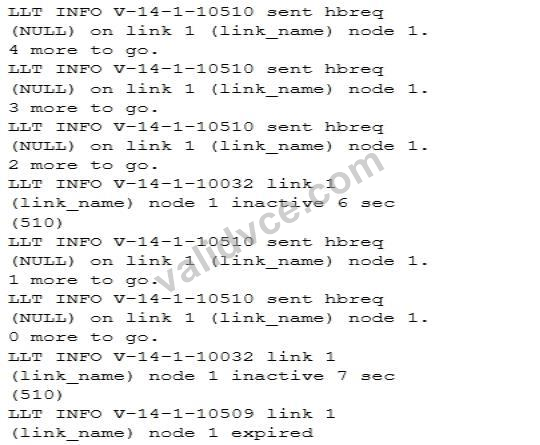
Which two actions should the administrator take to determine and resolve the issue? (Select two.)
- A. Check the content of the /etc/11ttab file
- B. Verify the NIC agent is started
- C. Check the NIC/link health and replace the NIC/Link of necessary.
- D. Check whether the link has become physically disconnected from the system or switch
- E. Foreceful restart itt with 11config
Correct Answer: A,C 🗳️
An administrator is evaluating the suitability of an application to be clustered using Veritas InfoScale Availability.
Which condition prevents the application from being made highly available?
- A. The application requires the use of solid state drives for performance.
- B. The application has a dependency on the host name of the system on which it is running.
- C. After a crash, the automated clean-up takes at least one minute before the application can be restarted.
- D. The application requires multiple systems accessing shared data simultaneously.
Correct Answer: C 🗳️
Which attributes are required for configuring the Oracle agent for Veritas Cluster Server?
- A. User, EnvFile
- B. SID, Owner, Home
- C. SID, DBAUser, DBAPword
- D. SID, Owner, MonitorOption
Correct Answer: B 🗳️
As part of the consolidation efforts in a data center, the administrator decides to merge two two-node Veritas Cluster Server (VCS) clusters into a four-node VCS cluster. The source and target clusters are on the same networks for LLT communication. The administrator performs the following tasks as preparation for the merge while both clusters are still running:
* modifies /etc/llttab files on the source cluster systems so the cluster ID is changed to the cluster ID of the target cluster
* modifies /etc/llthosts files on all systems to include the four nodes
* modifies /etc/gabtab files on all systems to require the four systems to seed
* ensures the source cluster systems can see the fencing disks used by the target cluster
* copies the fencing configuration files from the target cluster systems to the source cluster systems
* adds the source cluster systems to the target cluster configuration using the hasys -add command After the preparation is complete, the administrator stops the source cluster leaving the applications running, then stops the whole communication stack and restarts it in the correct order. When the administrator attempts to start the cluster again on the source cluster systems, they fail to join the four-node cluster.
Which preparation step that the administrator failed to perform is preventing the source cluster systems from joining the four-node cluster?
- A. The target main.cf file needs to be copied to the source cluster systems.
- B. The cluster UUID from the target cluster needs to be copied to the source cluster.
- C. The cluster needs to be manually seeded using gabconfig -x on the source cluster systems.
- D. The service group configuration of the source cluster needs to be applied to the target cluster.
Correct Answer: B 🗳️
An administrator manually edits the Veritas Cluster Server configuration file while a cluster is stopped. When the cluster is restarted, all the changes made are missing. Why are the changes made to the configuration file missing?
- A. The cluster was started first on a node other than the one where the changes were made.
- B. The haconf -dump command needs to be run prior to starting the cluster.
- C. The cluster was started first on the node where the changes were made.
- D. The haconf -save command needs to be run after making the manual changes.
Correct Answer: A 🗳️
Viewing page 1 out of 18 pages.
Viewing questions 1-5 out of 86 questions.


 863 Customer Reviews


