

Updated Nov-2025 Exam Materials for You to Prepare & Pass ADA-C01 Exam.
Pass Your ADA-C01 Exam at the First Try with 100% Real Exam
Snowflake ADA-C01 Exam Syllabus Topics:
| Topic | Details |
|---|---|
| Topic 1 |
|
| Topic 2 |
|
| Topic 3 |
|
| Topic 4 |
|
NEW QUESTION # 43
What are the MINIMUM grants required on the database, schema, and table for a stream to be properly created and managed?
- A. Database: Usage
Schema: Usage
Table: Select - B. Database: Usage, Create Stream
Schema: Usage
Table: Select - C. Database: Usage
Schema: Usage, Create Stream
Table: Select - D. Database: Usage
Schema: Usage
Table: Select, Create Stream
Answer: D
NEW QUESTION # 44
Which type of listing in the Snowflake Marketplace can be added and queried immediately?
- A. Personalized listing
- B. Monetized listing
- C. Standard listing
- D. Regional listing
Answer: C
Explanation:
Explanation
According to the Snowflake documentation1, a standard listing is a type of listing that provides free access to the full data product, with no payment required. A standard listing can be added andqueried immediately by the consumer, as long as they accept the terms and conditions of the listing. A monetized listing is a type of listing that charges for access to the data product, using the pricing models offered by Snowflake. A monetized listing requires the consumer to provide payment information and agree to the billing terms before accessing the data product. A regional listing is not a type of listing, but a way to specify the regions where the listing is available. A personalized listing is a type of listing that provides limited trial access to the data product, with unlimited access to the full data product available upon request. A personalized listing requires the consumer to request access from the provider and wait for the provider to grant access before accessing the data product.
Therefore, the only type of listing that can be added and queried immediately is the standard listing.
NEW QUESTION # 45
A Snowflake user runs a complex SQL query on a dedicated virtual warehouse that reads a large amount of data from micro-partitions. The same user wants to run another query that uses the same data set.
Which action would provide optimal performance for the second SQL query?
- A. Prevent the virtual warehouse from suspending between the running of the first and secondqueries.
- B. Assign additional clusters to the virtual warehouse.
- C. Use the RESULT_SCAN function to post-process the output of the first query.
- D. Increase the STATEMENT_TIMEOUT_IN_SECONDS parameter in the session.
Answer: C
Explanation:
Explanation
According to the Using Persisted Query Results documentation, the RESULT_SCAN function allows you to query the result set of a previous command as if it were a table. This can improve the performance of the second query by avoiding reading the same data from micro-partitions again. The other actions do not provide optimal performance for the second query because:
*Assigning additional clusters to the virtual warehouse does not affect the data access speed, but only the query execution speed. It also increases the cost of the warehouse.
*Increasing the STATEMENT_TIMEOUT_IN_SECONDS parameter in the session does not improve the performance of the query, but only allows it to run longer before timing out. It also increases the risk of resource contention and deadlock.
*Preventing the virtual warehouse from suspending between the running of the first and second queries does not guarantee that the data will be cached in memory, as Snowflake uses a least recently used (LRU) cache eviction policy. It also increases the cost of the warehouse.
https://docs.snowflake.com/en/user-guide/querying-persisted-results
NEW QUESTION # 46
Review the output of the SHOW statement below which displays the current grants on the table DB1. S1. T1: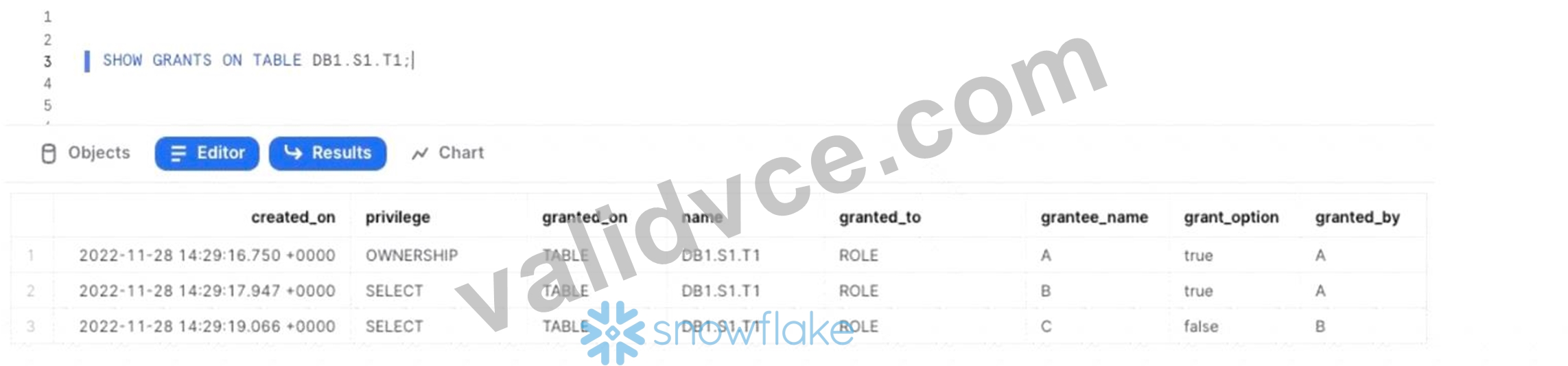
This statement is executed:
USE ROLE ACCOUNTADMIN;
DROP ROLE A;
What will occur?
- A. The OWNERSHIP privilege on table DB1. S1. T1 will be transferred to the ACCOUNTADMIN role.
- B. The SELECT privileges for roles B and C will remain.
- C. The table object DB1. S1. T1 will be dropped.
- D. The SELECT privilege on table DB1. S1. T1 to role B will be shown as GRANTED_BY the role ACCOUNTADMIN.
Answer: B
Explanation:
Explanation
Dropping role A does not affect the SELECT privileges granted to roles B and C on the table DB1.S1.T1.
According to the Snowflake documentation, dropping a role revokes all privileges granted to the role, but does not revoke any privileges granted by the role. Therefore, the OWNERSHIP privilege on the table DB1.S1.T1 will be revoked from role A, but the SELECT privileges granted by role A to role B and by role B to role C will remain. The GRANTED_BY column will still show the original grantor of the privilege, not the ACCOUNTADMIN role.
NEW QUESTION # 47
A user with the proper role issues the following commands when setting up and activating network policies:
CREATE OR REPLACE NETWORK POLICY foo_policy
ALLOWED_IP_LIST = ( '1.1.1.0/24', '2.2.2.0/24' , '3.3. 3. 0/24' )
BLOCKED IP LIST = ( '1.1.1.1')
COMMENT = 'Account level policy';
ALTER ACCOUNT SET NETWORK_POLICY=FOO_POLICY;
CREATE OR REPLACE NETWORK POLICY bar_policy
ALLOWED_IP_LIST = ('3.3.3.0/24')
BLOCKED IP LIST = ('3.3.3.10')
COMMENT = 'user level policy';
ALTER USER userl SET NETWORK_POLICY=BAR_POLICY;
Afterwards, user1 attempts to log in to Snowflake from IP address 3.3.3.10.
Will the login be successful?
- A. Yes, because 3.3.3.10 is found in the ALLOWED_IP_LIST of bar_policy.
- B. No, because 3.3.3.10 is found in the BLOCKED_IP_LIST of bar_policy.
- C. Yes, because 3.3.3.10 is found in the ALLOWED_IP_LIST of foo_policy.
- D. No, because 3.3.3.10 is not found in the ALLOWED_IP_LIST of foo_policy.
Answer: B
Explanation:
According to the Snowflake documentation1, network policies are a feature that allows restricting access to your account based on user IP address. A network policy can be applied to an account, a user, or a security integration, and can specify a list of allowed IP addresses and a list of blocked IP addresses. If there are network policies applied to more than one of these, the most specific network policy overrides more general network policies. In this case, the user1 has a network policy (bar_policy) applied to them, which overrides the account-level network policy (foo_policy). The bar_policy allows access only from the IP range 3.3.3.0/24, and blocks access from the IP address 3.3.3.10. Therefore, the user1 will not be able to log in to Snowflake from IP address 3.3.3.10, as it is found in the BLOCKED_IP_LIST of bar_policy. Option A is incorrect because the ALLOWED_IP_LIST of bar_policy does not override the BLOCKED_IP_LIST of bar_policy. Option C is incorrect because the ALLOWED_IP_LIST of foo_policy does not apply to user1, as it is overridden by the user-level network policy. Option D is incorrect because the ALLOWED_IP_LIST of foo_policy does not matter, as it is overridden by the user-level network policy.
NEW QUESTION # 48
Which commands can be performed by a user with the ORGADMIN role but not the ACCOUNTADMIN role? (Select TWO).
- A. SHOW REGIONS;
- B. SHOW USERS;
- C. SHOW ORGANIZATION ACCOUNTS;
- D. GRANT ROLE ORGADMIN TO USER <username>;
- E. SELECT SYSTEM$GLOBAL_ACCOUNT_SET_PARAMETER (
Answer: C,E
Explanation:
'ACCOUNT LOCATOR',
'ENABLE ACCOUNT DATABASE_REPLICATION',
'true'
);
Explanation:
According to the Snowflake documentation1, the ORGADMIN role is a special system role that is responsible for managing operations at the organization level, such as creating and viewing accounts, enabling database replication, and setting global account parameters. The ACCOUNTADMIN role is a system role that is responsible for managing operations at the account level, such as creating and managing users, roles, warehouses, databases, and shares. Therefore, the commands that can be performed by the ORGADMIN role but not the ACCOUNTADMIN role are:
* SHOW ORGANIZATION ACCOUNTS: This command lists all the accounts in the organization and their properties, such as region, edition, and status2. The ACCOUNTADMIN role can only show the current account and its properties using the SHOW ACCOUNTS command3.
* SELECT SYSTEM$GLOBAL_ACCOUNT_SET_PARAMETER: This function sets a global account parameter for an account in the organization, such as enabling account database replication4. The ACCOUNTADMIN role can only set local account parameters using the ALTER ACCOUNT command.
Option A is incorrect because the SHOW REGIONS command can be executed by any role, not just the ORGADMIN role. Option B is incorrect because the SHOW USERS command can be executed by the ACCOUNTADMIN role, as well as any role that has been granted the MONITOR privilege on the account. Option D is incorrect because the GRANT ROLE ORGADMIN TO USER <username> command can be executed by the ACCOUNTADMIN role, as well as any role that has been granted the ORGADMIN role1.
NEW QUESTION # 49
A Snowflake user runs a complex SQL query on a dedicated virtual warehouse that reads a large amount of data from micro-partitions. The same user wants to run another query that uses the same data set.
Which action would provide optimal performance for the second SQL query?
- A. Assign additional clusters to the virtual warehouse.
- B. Use the RESULT_SCAN function to post-process the output of the first query.
- C. Increase the STATEMENT_TIMEOUT_IN_SECONDS parameter in the session.
- D. Prevent the virtual warehouse from suspending between the running of the first and second queries.
Answer: B
Explanation:
According to the Using Persisted Query Results documentation, the RESULT_SCAN function allows you to query the result set of a previous command as if it were a table. This can improve the performance of the second query by avoiding reading the same data from micro-partitions again. The other actions do not provide optimal performance for the second query because:
* Assigning additional clusters to the virtual warehouse does not affect the data access speed, but only the query execution speed. It also increases the cost of the warehouse.
* Increasing the STATEMENT_TIMEOUT_IN_SECONDS parameter in the session does not improve the performance of the query, but only allows it to run longer before timing out. It also increases the risk of resource contention and deadlock.
* Preventing the virtual warehouse from suspending between the running of the first and second queries does not guarantee that the data will be cached in memory, as Snowflake uses a least recently used (LRU) cache eviction policy. It also increases the cost of the warehouse.
https://docs.snowflake.com/en/user-guide/querying-persisted-results
NEW QUESTION # 50
A Snowflake organization MYORG consists of two Snowflake accounts:
The ACCOUNT1 has a database PROD_DB and the ORGADMIN role enabled.
Management wants to have the PROD_DB database replicated to ACCOUNT2.
Are there any necessary configuration steps in ACCOUNT1 before the database replication can be configured and initiated in ACCOUNT2?
- A. No configuration steps are necessary in ACCOUNT1. Replicating databases across accounts within the same Snowflake organization is enabled by default.
- B. USE ROLE ORGADMIN;
SELECT SYSTEMSGLOBAL_ACCOUNT_SET_PARAMETER ('MYORG. ACCOUNT1', 'ENABLE_ACCOUNT_DATABASE_REPLICATION', 'TRUE'); SELECT SYSTEMSGLOBAL_ACCOUNT_SET_PARAMETER ('MYORG. ACCOUNT2', 'ENABLE_ACCOUNT_DATABASE_REPLICATION', 'TRUE'); USE ROLE ACCOUNTADMIN; ALTER DATABASE PROD DB ENABLE REPLICATION TO ACCOUNTS MYORG. ACCOUNT2; - C. USE ROLE ORGADMIN;
SELECT SYSTEMSGLOBAL ACCOUNT SET_PARAMETER ( 'MYORG. ACCOUNT1', 'ENABLE_ACCOUNT_DATABASE_REPLICATION', 'TRUE'); USE ROLE ACCOUNTADMIN; ALTER DATABASE PROD_DB ENABLE REPLICATION TO ACCOUNTS MYORG. ACCOUNT2 IGNORE EDITION CHECK; - D. It is not possible to replicate a database from an Enterprise edition Snowflake account to a Standard edition Snowflake account.
Answer: C
Explanation:
According to the Snowflake documentation1, database replication across accounts within the same organization requires the following steps:
* Link the accounts in the organization using the ORGADMIN role.
* Enable account database replication for both the source and target accounts using the SYSTEM$GLOBAL_ACCOUNT_SET_PARAMETER function.
* Promote a local database to serve as the primary database and enable replication to the target accounts using the ALTER DATABASE ... ENABLE REPLICATION TO ACCOUNTS command.
* Create a secondary database in the target account using the CREATE DATABASE ... FROM SHARE command.
* Refresh the secondary database periodically using the ALTER DATABASE ... REFRESH command.
Option A is incorrect because it does not include the step of creating a secondary database in the target account. Option C is incorrect because replicating databases across accounts within the same organization is not enabled by default, but requires enabling account database replication for both the source and target accounts. Option D is incorrect because it is possible to replicate a database from an Enterprise edition Snowflake account to a Standard edition Snowflake account, as long as the IGNORE EDITION CHECK option is used in the ALTER DATABASE ... ENABLE REPLICATION TO ACCOUNTS command2. Option B is correct because it includes all the necessary configuration steps in ACCOUNT1, except for creating a secondary database in ACCOUNT2, which can be done after the replication is enabled.
NEW QUESTION # 51
What roles can be used to create network policies within Snowflake accounts? (Select THREE).
- A. Any role that owns the database where the network policy is created
- B. ORGADMIN
- C. Any role with the global permission of CREATE NETWORK POLICY
- D. ACCOUNTADMIN
- E. SECURITYADMIN
- F. SYSADMIN
Answer: C,D,E
NEW QUESTION # 52
What session parameter can be used to test the integrity of secure views based on the account that is accessing that view?
- A. TEST_ACCOUNT_ID
- B. SIMULATED_DATA_SHARING_CONSUMER
- C. MIMIC_CONSUMER_ACCOUNT
- D. PRODUCER_TEST_ACCT
Answer: B
Explanation:
The SIMULATED_DATA_SHARING_CONSUMER session parameter allows a data provider to test the integrity of secure views based on the account that is accessing that view2. By setting this parameter to the name of the consumer account, the data provider can query the secure view and see the results that a user in the consumer account will see2. This helps to ensure that sensitive data in a shared database is not exposed to unauthorized users1. The other options are not valid session parameters in Snowflake3
NEW QUESTION # 53
The ACCOUNTADMIN of Account 123 works with Snowflake Support to set up a Data Exchange. After the exchange is populated with listings from other Snowflake accounts, what roles in Account 123 are allowed to request and get data?
- A. Only the ACCOUNTADMIN role, and no other roles
- B. Any role with IMPORT SHARE and CREATE DATABASE privileges
- C. Any role that the listing provider has designated as authorized
- D. Any role with USAGE privilege on the Data Exchange
Answer: D
Explanation:
To request and get data from a Data Exchange, the role in Account 123 must have the USAGE privilege on the Data Exchange object. This privilege allows the role to view the listings and request access to the data. According to the Snowflake documentation, "To view the listings in a data exchange, a role must have the USAGE privilege on the data exchange object. To request access to a listing, a role must have the USAGE privilege on the data exchange object and the IMPORT SHARE privilege on the account." The other options are either incorrect or not sufficient to request and get data from a Data Exchange. Option A is incorrect, as the ACCOUNTADMIN role is not the only role that can request and get data, as long as other roles have the necessary privileges. Option C is incorrect, as the IMPORT SHARE and CREATE DATABASE privileges are not required to request and get data, but only to create a database from a share after the access is granted. Option D is incorrect, as the listing provider does not designate the authorized roles in Account 123, but only approves or denies the requests from Account 123.
NEW QUESTION # 54
What are characteristics of Dynamic Data Masking? (Select TWO).
- A. The role that creates the masking policy will always see unmasked data in query results.
- B. A masking policy that is currently set on a table can be dropped.
- C. A single masking policy can be applied to columns with different data types.
- D. A single masking policy can be applied to columns in different tables.
- E. A masking policy can be applied to the VALUE column of an external table.
Answer: C,D
Explanation:
Explanation
According to the Using Dynamic Data Masking documentation, Dynamic Data Masking is a feature that allows you to alter sections of data in table and view columns at query time using a predefined masking strategy. The following are some of the characteristics of Dynamic Data Masking:
*A single masking policy can be applied to columns in different tables. This means that you can write a policy once and have it apply to thousands of columns across databases and schemas.
*A single masking policy can be applied to columns with different data types. This means that you can use the same masking strategy for columns that store different kinds of data, such as strings, numbers, dates, etc.
*A masking policy that is currently set on a table can be dropped. This means that you can remove the masking policy from the table and restore the original data visibility.
*A masking policy can be applied to the VALUE column of an external table. This means that you can mask data that is stored in an external stage and queried through an external table.
*The role that creates the masking policy will always see unmasked data in query results. This is not true, as the masking policy can also apply to the creator role depending on the execution context conditions defined in the policy. For example, if the policy specifies that only users with a certain custom entitlement can see the unmasked data, then the creator role will also need to have that entitlement to see the unmasked data.
NEW QUESTION # 55
A company has many users in the role ANALYST who routinely query Snowflake through a reporting tool. The Administrator has noticed that the ANALYST users keep two small clusters busy all of the time, and occasionally they need three or four clusters of that size.
Based on this scenario, how should the Administrator set up a virtual warehouse to MOST efficiently support this group of users?
- A. Create four virtual warehouses (sized Small through XL) and set them to auto-suspend and auto-resume. Have users in the ANALYST role select the appropriate warehouse based on how many queries are being run.
- B. Create a multi-cluster warehouse with MIN_CLUSTERS set to 2. Set the warehouse to auto-resume and auto-suspend, and give USAGE privileges to the ANALYST role. Allow the warehouse to auto-scale.
- C. Create a multi-cluster warehouse with MIN_CLUSTERS set to 1. Give MANAGE privileges to the ANALYST role so this group can start and stop the warehouse, and increase the number of clusters as needed.
- D. Create a standard X-Large warehouse, which is equivalent to four small clusters. Set the warehouse to auto-resume and auto-suspend, and give USAGE privileges to the ANALYST role.
Answer: B
Explanation:
According to the Snowflake documentation1, a multi-cluster warehouse is a virtual warehouse that consists of multiple clusters of compute resources that can scale up or down automatically to handle the concurrency and performance needs of the queries submitted to the warehouse. A multi-cluster warehouse has a minimum and maximum number of clusters that can be specified by the administrator. Option B is the most efficient way to support the group of users, as it allows the administrator to create a multi-cluster warehouse with MIN_CLUSTERS set to 2, which means that the warehouse will always have two clusters running to handle the standard workload. The warehouse can also auto-scale up to the maximum number of clusters (which can be set according to the peak workload) when there is a spike in demand, and then scale down when the demand decreases. The warehouse can also auto-resume and auto-suspend, which means that the warehouse will automatically start when a query is submitted and automatically stop after a period of inactivity. The administrator can also give USAGE privileges to the ANALYST role, which means that the users can use the warehouse to execute queries and load data, but not modify or operate the warehouse. Option A is not efficient, as it requires the users to manually start and stop the warehouse, and increase the number of clusters as needed, which can be time-consuming and error-prone. Option C is not efficient, as it creates a standard X-Large warehouse, which is equivalent to four small clusters, which may be more than needed for the standard workload, and may not be enough for the peak workload. Option D is not efficient, as it creates four virtual warehouses of different sizes, which can be confusing and cumbersome for the users to select the appropriate warehouse based on how many queries are being run, and may also result in wasted resources and costs.
NEW QUESTION # 56
Which statement allows this user to access this Snowflake account from a specific IP address (192.168.1.100) while blocking their access from anywhere else?
- A. CREATE OR REPLACE NETWORK POLICY ADMIN_POLICY
ALLOWED_IP_LIST = ('192.168. 1. 100/0') ;
ALTER USER ABC SET NETWORK_POLICY = 'ADMIN_POLICY'; - B. CREATE NETWORK POLICY ADMIN POLICY
ALLOWED_IP_LIST = ('192.168.1.100');
ALTER ROLE ACCOUNTADMIN SET NETWORK_POLICY = 'ADMIN_POLICY'; - C. CREATE NETWORK POLICY ADMIN_POLICY
ALLOWED IP LIST = ('192.168.1.100')
BLOCKED_IP_LIST = ('0.0.0.0/0');
ALTER USER ABC SET NETWORK_POLICY = 'ADMIN_POLICY'; - D. CREATE NETWORK POLICY ADMIN_POLICY
ALLOWED_IP_LIST = ('192.168.1.100');
ALTER USER ABC SET NETWORK_POLICY = 'ADMIN_POLICY';
User ABC is the only user with an ACCOUNTADMIN role.
Answer: C
Explanation:
Option C creates a network policy that allows only the IP address 192.168.1.100 and blocks all other IP addresses using the CIDR notation 0.0.0.0/01. It then applies the network policy to the user ABC, who has the ACCOUNTADMIN role. This ensures that only this user can access the Snowflake account from the specified IP address, while blocking their access from anywhere else. Option A does not block any other IP addresses, option B applies the network policy to the role instead of the user, and option D uses an invalid CIDR notation.
NEW QUESTION # 57
An organization's sales team leverages this Snowflake query a few times a day:
SELECT CUSTOMER ID, CUSTOMER_NAME, ADDRESS, PHONE NO
FROM CUSTOMERS
WHERE LAST UPDATED BETWEEN TO_DATE (CURRENT_TIMESTAMP) AND (TO_DATE
(CURRENT_TIMESTAMP) -7);
What can the Snowflake Administrator do to optimize the use of persisted query results whenever possible?
- A. Assign everyone on the sales team to the same virtual warehouse.
- B. Wrap the query in a User-Defined Function (UDF) to match syntax execution.
- C. Assign everyone on the sales team to the same security role.
- D. Leverage the CURRENT_DATE function for date calculations.
Answer: D
Explanation:
Explanation
According to the web search results from my predefined tool search_web, one of the factors that affects the reuse of persisted query results is the exact match of the query syntax1. If the query contains functions that return different values for successive runs, such as CURRENT_TIMESTAMP, then the query will not match the previous query and will not benefit from the cache. To avoid this, the query should use functions that return consistent values for the same day, such as CURRENT_DATE, which returns the current date without the time component2. Option A is incorrect because wrapping the query in a UDF does not guarantee the syntax match, as the UDF may also contain dynamic functions. Option B is incorrect because the virtual warehouse does not affect the persisted query results, which are stored at the account level1. Option C is incorrect because the security role does not affect the persisted query results, as long as the role has the necessary privileges to access the tables and views used in the query1.
1: Using Persisted Query Results | Snowflake Documentation 2: Date and Time Functions | Snowflake Documentation
NEW QUESTION # 58
......
Updated ADA-C01 Certification Exam Sample Questions: https://freedumps.validvce.com/ADA-C01-exam-collection.html
