

Attested 300-410 Dumps PDF Resource [2025]
Latest 300-410 Actual Free Exam Questions Updated 615 Questions
NEW QUESTION # 248
Refer to the exhibit.
An engineer configures the router 10.1.100.10 for EIGRP autosummarization so that R1 should receive the summary route of 10.0.0.0/8. However, R1 receives more specific /24 routes.
Which action resolves this issue?
- A. Router 10.1.100.10 should configure ip route 10.0.0.0 255.0.0.0 null 0 for the routes that are summarized toward R1.
- B. Router R1 should configure ip route 10.0.0.0 255.0.0.0 null 0 for the routes that are received on R1.
- C. Router 10.1.100.10 should configure ip summary address eigrp (AS number) 10.0.0.0 255.0.0.0 for the R1 Fast Ethernet 0/0 connected interface.
- D. Router R1 should configure ip summary address eigrp (AS number) 10.0.0.0 255.0.0.0 for the R1 Fast Ethernet 0/0 connected interface.
Answer: C
NEW QUESTION # 249
Refer to the exhibit. A network administrator configured NTP on a Cisco router to get synchronized time for system and logs from a unified time source The configuration did not work as desired Which service must be enabled to resolve the issue?
- A. Enter the service timestamps log datetime console global command.
- B. Enter the service timestamps log datetime clock-period global command
- C. Enter the service timestamps log datetime localtime global command.
- D. Enter the service timestamps log datetime synchronize global command.
Answer: C
Explanation:
If a router is configured to get the time from a Network Time Protocol (NTP) server, the times in the router's log entries may be different from the time on the systemclock if the [localtime] option is not in the service timestamps log command. To solve this issue, add the [localtime] option to the service timestamps log command. Thetimes should now be synchronized between the system clock and the log message timestamps.
NEW QUESTION # 250 
Refer to the exhibit. An administrator wanted to make R1 always elected as DR. R2 as BDR. and R3 as DROTHER but could not achieve the desired results. Which two configurations resolve the issue? (Choose two.)
- A. On the R2 FO/0 interface, configure OSPF priority to 200.
- B. On the R3 FO'O interface, configure OSPF priority to 201.
- C. On the R1 F0/0 interface, configure OSPF priority to 202.
- D. On the R1 FO/0 interface, configure OSPF priority to 255.
- E. On the R2 FO/0 interface, configure OSPF priority to 201.
Answer: B,D
NEW QUESTION # 251
Which of the following are valid restrictions when configuring Control Plane Policing (CoPP) on Cisco devices? (Choose two.)
- A. You cannot use the "log" keyword with CoPP on the access list entries
- B. Only standard access-lists are supported.
- C. CEF must be disabled
- D. The only match types supported with CoPP is ip precedence, ip dscp, and access-group
Answer: A,D
NEW QUESTION # 252
Drag and drop the packet types from the left onto the correct descriptions on the right.
Answer:
Explanation:
Explanation
Unlike legacy network technologies such as ISDN, Frame Relay, and ATM that defined separate data and control channels, IP carries all packets within a single pipe. Thus, IP network devices such as routers and switches must be able to distinguish between data plane, control plane, and management plane packets to treat each packet appropriately.From an IP traffic plane perspective, packets may be divided into four distinct, logical groups:1. Data plane packets - End-station, user-generated packets that are always forwarded by network devices to other end-station devices. From the perspective of the network device, data plane packets always have a transit destination IP address and can be handled by normal, destination IP address-based forwarding processes.2. Control plane packets - Network device generated or received packets that are used for the creation and operation of the network itself. From the perspective of the network device, control plane packets always have a receive destination IP address and are handled by the CPU in the network device route processor. Examples include protocols such as ARP, BGP, OSPF, and other protocols that glue the network together.3. Management plane packets - Network device generated or received packets, or management station generated or received packets that are used to manage the network. From the perspective of the network device, management plane packets always have a receive destination IP address and are handled by the CPU in the network device route processor. Examples include protocols such as Telnet, Secure Shell (SSH), TFTP, SNMP, FTP, NTP, and other protocols used to manage the device and/or network.4. Services plane packets - A special case of data plane packets, services plane packets are also user-generated packets that are also forwarded by network devices to other end-station devices, but that require high-touch handling by the network device (above and beyond normal, destination IP address-based forwarding) to forward the packet. Examples of high-touch handling include such functions as GRE encapsulation, QoS, MPLS VPNs, and SSL/IPsec encryption/decryption, etc. From the perspective of the network device, services plane packets may have a transit destination IP address, or may have a receive destination IP address (for example, in the case of a VPN tunnel endpoint).
NEW QUESTION # 253
Refer to the exhibit.
A network administrator is discovering a Cisco Catalyst 9300 and a Cisco WLC 3504 in Cisco DNA Center.
The Catalyst 9300 is added successfully However the WLC is showing [ error "uncontactable" when the administrator tries to add it in Cisco DNA Center. Which action discovers WLC in Cisco DNA Center successfully?
- A. Add the WLC 3504 under the hierarchy of the Catalyst 9300 connected devices.
- B. Delete the WLC 3504 from Cisco DNA Center and add it to Cisco DNA Center again.
- C. Copy the .cert file from the Cisco DNA Center on the USB and upload it to the WLC 3504.
- D. Copy the .pern file from the Cisco DNA Center on the USB and upload it to the WLC 3504.
Answer: D
Explanation:
https://www.cisco.com/c/en/us/support/docs/wireless/4400-series-wireless-lan-controllers/109597-csr- chained-certificates-wlc-00.html#anc12
NEW QUESTION # 254
Drag and Drop Question
Drag and drop the DHCP messages from the left onto the correct uses on the right.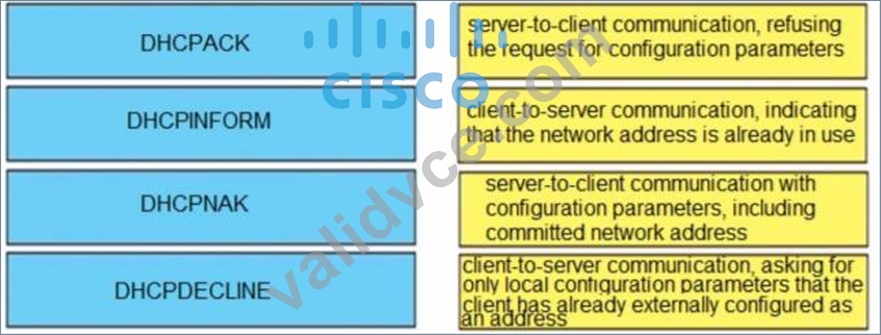
Answer:
Explanation:
NEW QUESTION # 255
Which attribute eliminates LFAs that belong to protected paths in situations where links in a network are connected through a common fiber?
- A. Lowest-repair-path-metric
- B. Shared risk link group-disjoint
- C. Linecard-disjoint
- D. Interface-dispoint
Answer: B
NEW QUESTION # 256 
Refer to the exhibit A network engineer notices that R1 and R2 cannot establish an eBGP peering. The following messages appear in the log:
Which configuration must the engineer apply to R1 to restore the eBGP peering?
- A.

- B.

- C.

- D.

Answer: D
NEW QUESTION # 257
What does the PE router convert the Ipv4 prefix to within an MPLS VPN?
- A. eBGP path association between the PE and CE sessions
- B. VPN-IPv4 prefix combined with the 64-bit route distinguisher
- C. 48-bit route combining the IP and PE router-id
- D. prefix that combines the ASN, PE router-id, and IP prefix
Answer: B
Explanation:
NEW QUESTION # 258
A network administrator is reloading a router and during the bootup, he is getting the error message "%Error opening tftp://255.255.255.255/network-confg (Socket error)". What command need to be applied on Cisco Router to fix this issue.
- A. Reload noconfirm
- B. Write erase reload
- C. No service config
- D. Copy run start
Answer: C
NEW QUESTION # 259 
Refer lo lhe exhibit. The Customer Edge rouler wants to use AS 100 as the preferred ISP for all external routes and ISP-2 as a backup.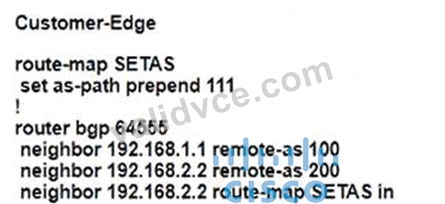
After this configuration, all the backup routes have disappeared from the BGP table on the Customer Edge router. Which set of configurations resolves the issue on the Customer Edge router?
- A.

- B.

- C.

- D.

Answer: B
NEW QUESTION # 260
How does an MPLS Layer 3 VPN function?
- A. multiple customer sites interconnect through service provider network to create secure tunnels between customer edge devices
- B. set of sites interconnect privately over the Internet for security
- C. multiple customer sites interconnect through a service provider network using customer edge to provider edge connectivity
- D. set of sites use multiprotocol BGP at the customer site for aggregation
Answer: A
NEW QUESTION # 261
Drag and drop the SNMP attributes in Cisco IOS devices from the left onto the correct SNMPv2c or SNMPV3 categories on the right.
Answer:
Explanation:

NEW QUESTION # 262
Refer to the exhibit. An engineer must establish a point-to-point GRE VPN between R1 and the remote site. Which configuration accomplishes the task for the remote site?
- A. Interface Tunnel1
tunnel source 199.1.1.1
tunnel destination 200.1.1.3
ip address 192.168.1.3 255.255.255.0 - B. Interface Tunnel1
tunnel source 200.1.1.3
tunnel destination 199.1.1.1
ip address 192.168.1.1.255.255.255.0 - C. Interface Tunnel
lunnel source 199.1.1.1
tunnel destination 200.1.1.3
ip address 192.168.1.1.255.255.255.0 - D. Interface Tunnel1
tunnel source 200.1.1.3
tunnel destination 199.1.1.1
ip address 192.168.1.3.255.255.255.0
Answer: D
NEW QUESTION # 263
Drag and drop the MPLS terms from the left onto the correct definitions on the right.
Answer:
Explanation:
NEW QUESTION # 264
What is the minimum time gap required by the local system before putting a BFD control packet on the wire?
- A. Required Min Echo RX Interval
- B. Desired Min TX Interval
- C. Required Min RX Interval
- D. Detect Mult
Answer: B
Explanation:
Desired Min TX Interval: This is the minimum interval, in microseconds, that the local system would like to use when transmitting BFD Control packets, less any jitter applied. The value zero is reserved.
Required Min Echo RX Interval: This is the minimum interval, in microseconds, between received BFD Echo packets that this system is capable of supporting, less any jitter applied by the sender.
If this value is zero, the transmitting system does not support the receipt of BFD Echo packets.
Reference: https://tools.ietf.org/html/rfc5880
NEW QUESTION # 265
Refer the exhibit. BGP is flapping after the Copp policy is applied.
What are the two solutions to fix the issue? (Choose two)
- A. Configure a three-color policer instead of two-color policer under Class COPP-CRIT1CAL-
7600 - B. Configure a higher value for CIR under the Class COPP-CRIT1CAL-7600
- C. Configure a higher value for CIR under the default class to allow more packets during peak traffic
- D. Configure IP CEF for CoPP policy and BGP to work
- E. Configure BGP in the COPP-CRIT1CAL-7600 ACL
Answer: C,E
Explanation:
The policy-map COPP-7600 only rate-limit HTTP & HTTPS traffic (based on the ACL conditions) so any BGP packets will be processed in the class "class-default", which drops exceeded BGP packets. Therefore we have two ways to solve this problem:
+ Add BGP to the ACL with the statement "permit tcp any any eq bgp"
+ Configure higher value for CIR in default class as 2Mbps is too low for web traffic (http & https)
NEW QUESTION # 266
Refer to the exhibit. Users in VLAN46 cannot get the IP from the DHCP server. Assume that all the parameters are configured properly in VLAN 10 and on the DHCP server Which command on interlace VLAN46 allows users to receive IP from the DHCP server?
- A. ip dhcp server 10.221.10.10
- B. ip dhcp relay information trust-all
- C. ip dhcp-addreos 10.221.10.10
- D. ip helper-addrets 10.221.10.10
Answer: D
NEW QUESTION # 267
Which IPv6 feature enables a device to reject traffic when it is originated from an address that is not stored in the device binding table?
- A. IPv6 Source Guard
- B. IPv6 DAD Proxy
- C. IPv6 Snooping
- D. IPv6 RA Guard
Answer: A
Explanation:
https://www.cisco.com/c/en/us/td/docs/ios-xml/ios/ipv6_fhsec/configuration/xe-3s/ip6f-xe-3s-book/ip6-src-guard.html
NEW QUESTION # 268
An engineer creates a default static route on a router with a hop of 10.1.1.1. On inspection, the engineer finds the router has two VRFs, Red and Blue. The next hop is valid for both VRFs and exists in each assigned VRF. Which configuration achieves connectivity?
A)
B)
C)
D)
- A. Option C
- B. Option B
- C. Option D
- D. Option A
Answer: D
NEW QUESTION # 269
Which of the following statements are true regarding the e IPv6 RA Guard feature?
- A. This feature is support on LAG bundles interfaces
- B. This feature offers protection in networks where IPv6 traffic is tunneled.
- C. This feature is supported on private VLANs
- D. Packets dropped by the IPv6 RA Guard feature cannot be spanned.
Answer: C
NEW QUESTION # 270
Drag and drop the IPv6 first hop security device roles from the left onto the corresponding descriptions on the right.
Answer:
Explanation:
Reference:
https://www.cisco.com/c/en/us/td/docs/switches/datacenter/nexus9000/sw/7-x/security/configuration/guide/b_Cisco_Nexus_9000_Series_NX-OS_Security_Configuration_Guide_7x/b_Cisco_Nexus_9000_Series_NX-OS_Security_Configuration_Guide_7x_chapter_011011.pdf
NEW QUESTION # 271
Which failure detection mechanism is used for BFD?
- A. Layer 2 protocol failure
- B. variable rate
- C. routing protocol failure
- D. consistent rate
Answer: D
NEW QUESTION # 272
......
How do you start to study for the Cisco Certified Specialist - Enterprise Advanced Infrastructure Implementation (300-410 ENARSI) Exam
Get the guide For Cisco Certified Specialist - Enterprise Advanced Infrastructure Implementation (300-410) Exam
Quick study guide if you don't have time to read complete the page
The Cisco 300-410 exam is considered to be one of the most difficult Cisco certification exams, but it is also one of the most rewarding. Passing this certification will validate your skills in managing networks with limited resources and will help you land a better job or get further in your current profession. It is never easy for a new IT graduate to find a job. They still need to work hard and complete their certification to get the job they want. The Cisco Certified Entry Network Technician (CCENT) is designed for people who already possess an understanding of networking and basic network infrastructures, such as switches, routers, and wireless networks. This certification allows you to qualify for jobs in network support and consulting positions. Cisco 300-410 Dumps is prepared by experts with 100% simulation questions and answers related to the actual exam. The qualified person may install, operate and troubleshoot a small enterprise network, including basic network security.
300-410 Certification Overview Latest 300-410 PDF Dumps: https://freedumps.validvce.com/300-410-exam-collection.html
