

Share Latest Mar-2026 DP-600Test Practice Test Questions, Exam Dumps
Positive Aspects of Valid Dumps DP-600 Exam Dumps!
Microsoft DP-600 Exam Syllabus Topics:
| Topic | Details |
|---|---|
| Topic 1 |
|
| Topic 2 |
|
| Topic 3 |
|
NEW QUESTION # 98
You have a Fabric warehouse that contains two tables named DimDate and Trips.
DimDate contains the following fields.
Trips contains the following fields.
You need to compare the average miles per trip for statutory holidays versus non-statutory holidays.
How should you complete the T-SQL statement? To answer, select the appropriate options in the answer area.
NOTE: Each correct selection is worth one point.
Answer:
Explanation: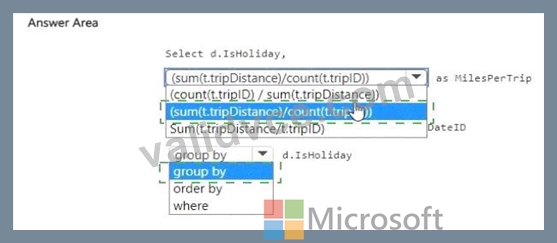
Explanation: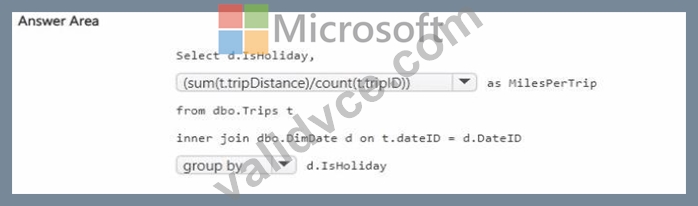
Comprehensive Detailed Explanation
Step 1: Requirement
We need to compare the average miles per trip for:
Statutory holidays (when IsHoliday = 1)
Non-statutory holidays (when IsHoliday = 0)
Step 2: Formula for average miles per trip
Average miles per trip = total miles ÷ number of trips
Total miles # SUM(t.tripDistance)
Number of trips # COUNT(t.tripID)
So the calculation is:
(SUM(t.tripDistance) / COUNT(t.tripID)) AS MilesPerTrip
Step 3: Grouping
We need a comparison by holiday status.
So we must group the results by:
GROUP BY d.IsHoliday
This ensures we get two rows: one for IsHoliday = 1 and one for IsHoliday = 0.
Step 4: Final Query
SELECT
d.IsHoliday,
(SUM(t.tripDistance) / COUNT(t.tripID)) AS MilesPerTrip
FROM DimDate d
INNER JOIN Trips t ON d.DateID = t.DateID
GROUP BY d.IsHoliday;
Why This is Correct
The formula ensures average miles per trip.
Grouping ensures comparison between holidays vs non-holidays.
Efficient aggregation, minimal computation.
References
Aggregate functions in T-SQL
GROUP BY clause
NEW QUESTION # 99
You need to ensure that Contoso can use version control to meet the data analytics requirements and the general requirements. What should you do?
- A. Modify the settings of the Research division workspaces to use an Azure Repos repository.
- B. Modify the settings of the Research workspaces to use a GitHub repository.
- C. Store all the semantic models and reports in Microsoft OneDrive.
- D. Store all the semantic models and reports in Data Lake Gen2 storage.
Answer: A
Explanation:
You need to ensure that Contoso can use version control to meet the data analytics requirements and the general requirements.
Requirement: "All the semantic models and reports for the Research division must use version control that supports branching." Fabric supports Git integration (Azure Repos or GitHub) for semantic models and reports.
Storing in Data Lake Gen2 or OneDrive does not provide version control with branching.
The correct action is to integrate workspaces with a Git repository.
The answer: D. Modify the settings of the Research division workspaces to use an Azure Repos repository.
NEW QUESTION # 100
Note: This section contains one or more sets of questions with the same scenario and problem. Each question presents a unique solution to the problem. You must determine whether the solution meets the stated goals. More than one solution in the set might solve the problem. It is also possible that none of the solutions in the set solve the problem.
After you answer a question in this section, you will NOT be able to return. As a result, these questions do not appear on the Review Screen.
Your network contains an on-premises Active Directory Domain Services (AD DS) domain named contoso.com that syncs with a Microsoft Entra tenant by using Microsoft Entra Connect.
You have a Fabric tenant that contains a semantic model.
You enable dynamic row-level security (RLS) for the mode! and deploy the model to the Fabric service.
You query a measure that includes the username () function, and the query returns a blank result.
You need to ensure that the measure returns the user principal name (UPNJ of a user.
Solution: You add user objects to the list of synced objects in Microsoft Entra Connect.
Does this meet the goal?
- A. No
- B. Yes
Answer: A
NEW QUESTION # 101
You have a Microsoft Power Bl semantic model that contains measures. The measures use multiple calculate functions and a filter function.
You are evaluating the performance of the measures.
In which use case will replacing the filter function with the keepfilters function reduce execution time?
- A. when the filter function references columns from multiple tables
- B. when the filter function uses a nested calculate function
- C. when the filter function references a measure
- D. when the filter function references a column from a single table that uses Import mode
Answer: B
Explanation:
The KEEPFILTERS function modifies the way filters are applied in calculations done through the CALCULATE function. It can be particularly beneficial to replace the FILTER function with KEEPFILTERS when the filter context is being overridden by nested CALCULATE functions, which may remove filters that are being applied on a column. This can potentially reduce execution time because KEEPFILTERS maintains the existing filter context and allows the nested CALCULATE functions to be evaluated more efficiently.
NEW QUESTION # 102
You have a Fabric tenant that contains 30 CSV files in OneLake. The files are updated daily.
You create a Microsoft Power Bl semantic model named Modell that uses the CSV files as a data source. You configure incremental refresh for Model 1 and publish the model to a Premium capacity in the Fabric tenant.
When you initiate a refresh of Model1, the refresh fails after running out of resources.
What is a possible cause of the failure?
- A. XMLA Endpoint is set to Read Only.
- B. Query folding is occurring.
- C. Query folding is NOT occurring.
- D. Only refresh complete days is selected.
- E. The data type of the column used to partition the data has changed.
Answer: C
Explanation:
A possible cause for the failure is that query folding is NOT occurring (D). Query folding helps optimize refresh by pushing down the query logic to the source system, reducing the amount of data processed and transferred, hence conserving resources. Reference = The Power BI documentation on incremental refresh and query folding provides detailed information on this topic.
NEW QUESTION # 103
You have a Fabric tenant that contains a lakehouse named Lakehouse1. Lakehouse1 contains a Delta table that has one million Parquet files.
You need to remove files that were NOT referenced by the table during the past 30 days. The solution must ensure that the transaction log remains consistent, and the ACID properties of the table are maintained.
What should you do?
- A. Run the OPTIMIZE command and specify the V-order parameter.
- B. Run the OPTIMIZE command and specify the Z-order parameter.
- C. Run the VACUUM command.
- D. From OneLake file explorer, delete the files.
Answer: C
Explanation:
To remove files from a Delta table that are no longer referenced by the current version of the table, you should run the VACUUM command.
https://learn.microsoft.com/en-us/fabric/data-engineering/lakehouse-table-maintenance
NEW QUESTION # 104
You have a Fabric warehouse that contains a table named Sales.Products. Sales.Products contains the following columns.
You need to write a T-SQL query that will return the following columns.
How should you complete the code? To answer, select the appropriate options in the answer area.
Answer:
Explanation:
NEW QUESTION # 105
You have a Fabric tenant that contains a workspace named Workspace1. Workspace1 contains a lakehouse named I.H1 and a warehouse named DW1. I.H1 contains a table named signindata that is in the dho schema.
You need to create a stored procedure in DW1 that deduplicates the data in the signindata table.
How should you complete the T-SQL statement? To answer, select the appropriate options in the answer area.
NOTE: Fach correct selection is worth one point.
Answer:
Explanation: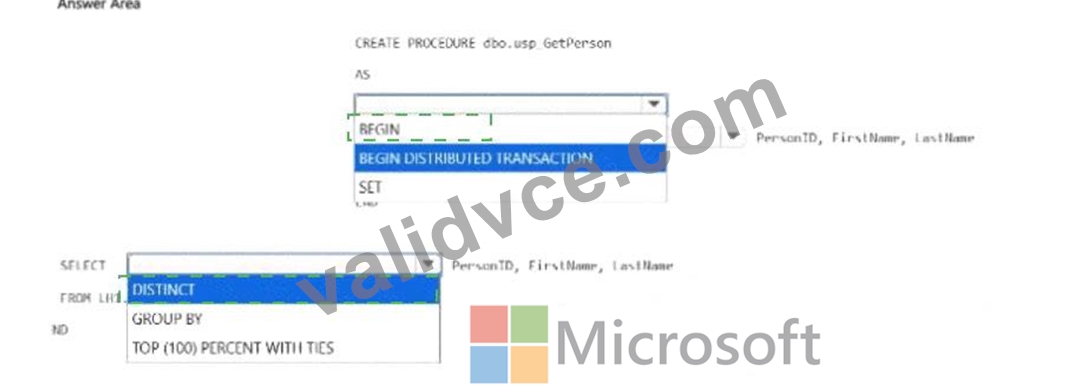
Explanation:
Scenario Recap
Fabric tenant # Workspace1
Contains:
Lakehouse LH1 (with table signindata in schema dho)
Warehouse DW1
Task: Create a stored procedure in DW1 that deduplicates rows in signindata.
Step 1: Stored procedure structure
In T-SQL, stored procedures begin with:
AS
BEGIN
-- logic
END
So the correct option for the first blank is BEGIN.
BEGIN DISTRIBUTED TRANSACTION is not needed because we are not spanning multiple servers or needing distributed transactions.
SET is not the right way to start the logic block.
Step 2: Deduplication logic
To remove duplicates from signindata, the query should return unique rows.
The simplest way is:
SELECT DISTINCT PersonID, FirstName, LastName
FROM dho.signindata;
Thus the correct choice for the second blank is DISTINCT.
GROUP BY could also deduplicate but is less efficient here since no aggregation is requested.
TOP 100 PERCENT WITH TIES is irrelevant.
Step 3: Final T-SQL stored procedure
CREATE PROCEDURE dbo.usp_GetPerson
AS
BEGIN
SELECT DISTINCT PersonID, FirstName, LastName
FROM dho.signindata;
END;
Why this is correct
BEGIN # correct stored procedure structure.
DISTINCT # ensures deduplication of rows from signindata.
References
CREATE PROCEDURE (Transact-SQL)
DISTINCT (Transact-SQL)
NEW QUESTION # 106
You have a Fabric workspace named Workspace 1 that contains a dataflow named Dataflow1. Dataflow! has a query that returns 2.000 rows. You view the query in Power Query as shown in the following exhibit.
What can you identify about the pickupLongitude column?
- A. The column has duplicate values.
- B. All the table rows are profiled.
- C. There are 935 values that occur only once.
- D. The column has missing values.
Answer: A
Explanation:
The pickupLongitude column has duplicate values. This can be inferred because the 'Distinct count' is 935 while the 'Count' is 1000, indicating that there are repeated values within the column. Reference = Microsoft Power BI documentation on data profiling could provide further insights into understanding and interpreting column statistics like these.
NEW QUESTION # 107
You have a Microsoft Power Bl report named Report1 that uses a Fabric semantic model.
Users discover that Report1 renders slowly.
You open Performance analyzer and identify that a visual named Orders By Date is the slowest to render. The duration breakdown for Orders By Date is shown in the following table.
What will provide the greatest reduction in the rendering duration of Report1?
- A. Enable automatic page refresh.
- B. Reduce the number of visuals in Report1.
- C. Optimize the DAX query of Orders By Date by using DAX Studio.
- D. Change the visual type of Orders By Dale.
Answer: B
Explanation:
Based on the duration breakdown provided, the major contributor to the rendering duration is categorized as
"Other," which is significantly higher than DAX Query and Visual display times. This suggests that the issue is less likely with the DAX calculation or visual rendering times and more likely related to model performance or the complexity of the visual. However, of the options provided, optimizing the DAX query can be a crucial step, even if "Other" factors are dominant. Using DAX Studio, you can analyze and optimize the DAX queries that power your visuals for performance improvements. Here's how you might proceed:
* Open DAX Studio and connect it to your Power BI report.
* Capture the DAX query generated by the Orders By Date visual.
* Use the Performance Analyzer feature within DAX Studio to analyze the query.
* Look for inefficiencies or long-running operations.
* Optimize the DAX query by simplifying measures, removing unnecessary calculations, or improving iterator functions.
* Test the optimized query to ensure it reduces the overall duration.
References: The use of DAX Studio for query optimization is a common best practice for improving Power BI report performance as outlined in the Power BI documentation.
NEW QUESTION # 108
You have a Fabric tenant that contains a lakehouse. You plan to use a visual query to merge two tables.
You need to ensure that the query returns all the rows that are present in both tables. Which type of join should you use?
- A. inner
- B. right anti
- C. left outer
- D. full outer
- E. right outer
- F. left anti
Answer: D
Explanation:
When you need to return all rows that are present in both tables, you use a full outer join. This type of join combines the results of both left and right outer joins and returns all rows from both tables, with matching rows from both sides where available. If there is no match, the result is NULL on the side of the join where there is no match.
NEW QUESTION # 109
You have a Fabric tenant that contains a warehouse. The warehouse uses row-level security (RLS). You create a Direct Lake semantic model that uses the Delta tables and RLS of the warehouse. When users interact with a report built from the model, which mode will be used by the DAX queries?
- A. Direct Lake
- B. Import
- C. Dual
- D. DirectQuery
Answer: A
NEW QUESTION # 110
You have a Fabric warehouse that contains a table named Sales.Orders. Sales.Orders contains the following columns.
You need to write a T-SQL query that will return the following columns.
How should you complete the code? To answer, select the appropriate options in the answer area.
NOTE: Each correct selection is worth one point.
Answer:
Explanation:
Explanation:
For the PeriodDate that returns the first day of the month for OrderDate, you should use DATEFROMPARTS as it allows you to construct a date from its individual components (year, month, day).
For the DayName that returns the name of the day for OrderDate, you should use DATENAME with the weekday date part to get the full name of the weekday.
The complete SQL query should look like this:
SELECT OrderID, CustomerID,
DATEFROMPARTS(YEAR(OrderDate), MONTH(OrderDate), 1) AS PeriodDate,
DATENAME(weekday, OrderDate) AS DayName
FROM Sales.Orders
Select DATEFROMPARTS for the PeriodDate and weekday for the DayName in the answer area.
NEW QUESTION # 111
Hotspot Question
You have two Microsoft Power BI queries named Employee and Retired Roles.
You need to merge the Employee query with the Retired Roles query. The solution must ensure that duplicate rows in each query are removed.
Which column and Join Kind should you use in Power Query Editor? To answer, select the appropriate options in the answer area.
NOTE: Each correct answer is worth one point.
Answer:
Explanation:
NEW QUESTION # 112
You have a Fabric tenant that contains a workspace named Workspace! Workspace1 uses the Pro license mode and contains a semantic model named Model1.
You have an Azure DevOps organization.
You need to enable version control for Workspace1. The solution must ensure that Model 1 is added to the repository.
Which three actions should you perform in sequence? To answer, move the appropriate actions from the list of actions to the answer area and arrange them in the correct order.
Answer:
Explanation:
Explanation:
NEW QUESTION # 113
You have a Fabric tenant that contains a lakehouse named lakehouse1. Lakehouse1 contains an unpartitioned table named Table1.
You plan to copy data to Table1 and partition the table based on a date column in the source data.
You create a Copy activity to copy the data to Table1.
You need to specify the partition column in the Destination settings of the Copy activity.
What should you do first?
- A. From the Source tab, select Enable partition discovery
- B. From the Destination tab, set Mode to Overwrite.
- C. From the Destination tab, set Mode to Append.
- D. From the Destination tab, select the partition column,
Answer: D
NEW QUESTION # 114
You have a Fabric tenant that contains a lakehouse named Lakehouse1
Readings from 100 loT devices are appended to a Delta table in Lakehouse1. Each set of readings is approximately 25 KB. Approximately 10 GB of data is received daily.
All the table and SparkSession settings are set to the default.
You discover that queries are slow to execute. In addition, the lakehouse storage contains data and log files that are no longer used.
You need to remove the files that are no longer used and combine small files into larger files with a target size of 1 GB per file.
What should you do? To answer, drag the appropriate actions to the correct requirements. Each action may be used once, more than once, or not at all. You may need to drag the split bar between panes or scroll to view content.
NOTE: Each correct selection is worth one point.
Answer:
Explanation:
Explanation:
* Remove the files: Run the VACUUM command on a schedule.
* Combine the files: Set the optimizeWrite table setting. or Run the OPTIMIZE command on a schedule.
To remove files that are no longer used, the VACUUM command is used in Delta Lake to clean up invalid files from a table. To combine smaller files into larger ones, you can either set the optimizeWrite setting to combine files during write operations or use the OPTIMIZE command, which is a Delta Lake operation used to compact small files into larger ones.
NEW QUESTION # 115
You have a Fabric tenant that contains a warehouse.
A user discovers that a report that usually takes two minutes to render has been running for 45 minutes and has still not rendered.
You need to identify what is preventing the report query from completing.
Which dynamic management view (DMV) should you use?
- A. sys.dm._exec._connections
- B. sys.dn_.exec._sessions
- C. sys.dm_pdw_exec_requests
- D. sys.dm-exec_requests
Answer: A
Explanation:
The correct DMV to identify what is preventing the report query from completing is sys.
dm_pdw_exec_requests (D). This DMV is specific to Microsoft Analytics Platform System (previously known as SQL Data Warehouse), which is the environment assumed to be used here. It provides information about all queries and load commands currently running or that have recently run. References = You can find more about DMVs in the Microsoft documentation for Analytics Platform System.
NEW QUESTION # 116
You have a Fabric tenant that contains a lakehouse.
You plan to query sales data files by using the SQL endpoint. The files will be in an Amazon Simple Storage Service (Amazon S3) storage bucket.
You need to recommend which file format to use and where to create a shortcut.
Which two actions should you include in the recommendation? Each correct answer presents part of the solution.
NOTE: Each correct answer is worth one point.
- A. Use the CSV format.
- B. Create a shortcut in the Tables section.
- C. Create a shortcut in the Files section.
- D. Use the delta format.
- E. Use the Parquet format
Answer: A,B
Explanation:
You should use the Parquet format (B) for the sales data files because it is optimized for performance with large datasets in analytical processing and create a shortcut in the Tables section (D) to facilitate SQL queries through the lakehouse's SQL endpoint. Reference = The best practices for working with file formats and shortcuts in a lakehouse environment are covered in the lakehouse and SQL endpoint documentation provided by the cloud data platform services.
NEW QUESTION # 117
You have a Fabric tenant that contains two workspaces named Woritspace1 and Workspace2. Workspace1 contains a lakehouse named Lakehouse1. Workspace2 contains a lakehouse named Lakehouse2. Lakehouse!
contains a table named dbo.Sales. Lakehouse2 contains a table named dbo.Customers.
You need to ensure that you can write queries that reference both dbo.Sales and dbo.Customers in the same SQL query without making additional copies of the tables.
What should you use?
- A. a dataflow
- B. a view
- C. a shortcut
- D. a managed table
Answer: C
Explanation:
In Microsoft Fabric, a shortcut lets you reference data from another workspace's Lakehouse or external storage without duplicating the data.
A view would only apply within the same database/Lakehouse, not across workspaces.
A dataflow transforms and loads data but creates a new copy.
A managed table is a physical table stored in the Lakehouse itself, not a cross-reference.
So, to query dbo.Sales (Lakehouse1) and dbo.Customers (Lakehouse2) in a single SQL query, you use shortcuts.
Reference: Shortcuts in OneLake
NEW QUESTION # 118
You have a Fabric warehouse named Warehouse1 that contains a table named dbo.Product. dbo.Product contains the following columns.
You need to use a T-SQL query to add a column named PriceRange to dbo.Product. The column must categorize each product based on UnitPrice. The solution must meet the following requirements:
* If UnitPrice is 0, PriceRange is "Not for resale".
* If UnitPrice is less than 50, PriceRange is "Under $50".
* If UnitPrice is between 50 and 250, PriceRange is "Under $250".
* In all other instances, PriceRange is "$250+".
How should you complete the query? To answer, drag the appropriate values to the correct targets. Each value may be used once, more than once, or not at all. You may need to drag the split bar between panes or scroll to view content.
NOTE: Each correct selection is worth one point.
Answer:
Explanation: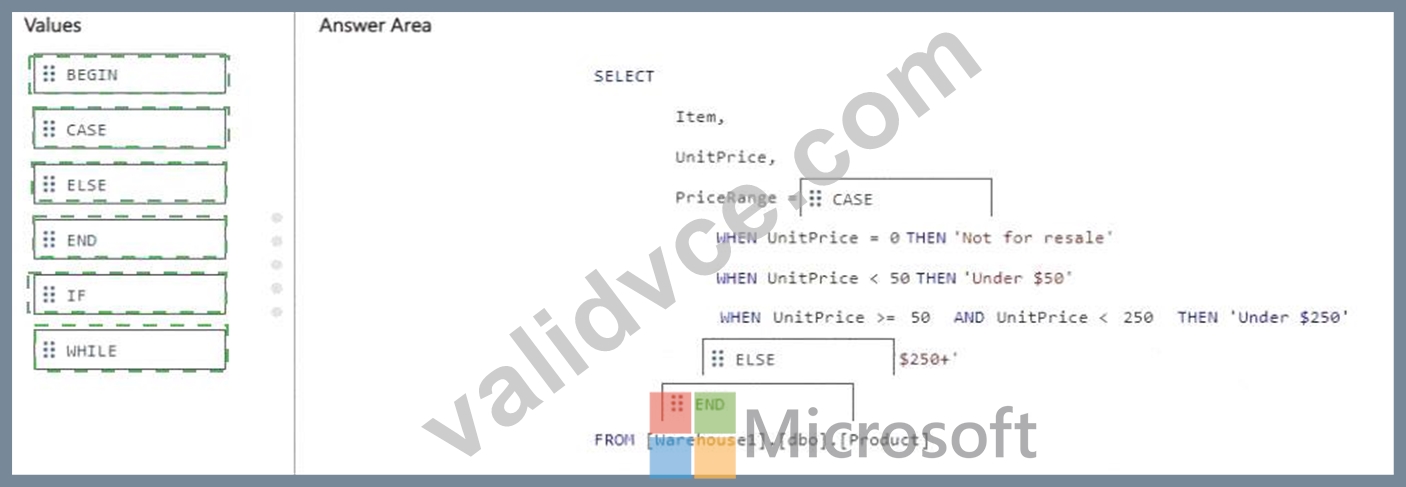
Explanation:
Comprehensive Detailed Explanation
We need to create a computed column PriceRange based on the UnitPrice column in the dbo.Product table.
Step 1: Requirements
If UnitPrice = 0 # "Not for resale"
If UnitPrice < 50 # "Under $50"
If UnitPrice >= 50 AND UnitPrice < 250 # "Under $250"
Otherwise # "$250+"
This matches a CASE expression in T-SQL.
Step 2: CASE Expression Structure
The syntax is:
CASE
WHEN condition THEN result
WHEN condition THEN result
ELSE result
END
Step 3: Apply to Problem
SELECT
Item,
UnitPrice,
PriceRange = CASE
WHEN UnitPrice = 0 THEN 'Not for resale'
WHEN UnitPrice < 50 THEN 'Under $50'
WHEN UnitPrice >= 50 AND UnitPrice < 250 THEN 'Under $250'
ELSE '$250+'
END
FROM [Warehouse1].[dbo].[Product];
Step 4: Why This is Correct
CASE starts the conditional evaluation.
ELSE handles the default branch ($250+).
END closes the expression.
Meets all requirements exactly.
References
CASE expression in T-SQL
Computed columns in T-SQL
NEW QUESTION # 119
You have the source data model shown in the following exhibit.
The primary keys of the tables are indicated by a key symbol beside the columns involved in each key.
You need to create a dimensional data model that will enable the analysis of order items by date, product, and customer.
What should you include in the solution? To answer, select the appropriate options in the answer area.
NOTE: Each correct selection is worth one point.
Answer:
Explanation:
Explanation:
* The relationship between OrderItem and Product must be based on: Both the CompanyID and the ProductID columns
* The Company entity must be: Denormalized into the Customer and Product entities In a dimensional model, the relationships are typically based on foreign key constraints between the fact table (OrderItem) and dimension tables (Product, Customer, Date). Since CompanyID is present in both the OrderItem and Product tables, it acts as a foreign key in the relationship. Similarly, ProductID is a foreign key that relates these two tables. To enable analysis by date, product, and customer, the Company entity would need to be denormalized into the Customer and Product entities to ensure that the relevant company information is available within those dimensions for querying and reporting purposes.
References =
* Dimensional modeling
* Star schema design
NEW QUESTION # 120
......
Practice LATEST DP-600 Exam Updated 166 Questions: https://freedumps.validvce.com/DP-600-exam-collection.html
