

The best study tool is the one you actually have when motivation hits. Order the Microsoft Configuring and Operating a Hybrid Cloud with Microsoft Azure Stack material from ValidVCE and the 070-537 files reach your mailbox within a minute — install them on every device you own.
Microsoft 070-537 Exam Syllabus Topics:
| Section | Objectives |
|---|---|
| Manage Azure Stack services and workloads | - Manage platform services
|
| Deploy and configure Azure Stack infrastructure | - Configure identity and registration
|
| Monitor and maintain Azure Stack environment | - Maintenance and updates
|
| Manage storage and networking | - Configure storage services
|
Everything You Ask About the 070-537 Exam
The official fee is USD 165 (may vary by region) per attempt, and the passing score is 700 / 1000. A failed attempt means paying the entire fee again — which makes the 105 practice questions from ValidVCE the cheaper rehearsal. Self-test until the pass mark feels routine, then book.
Your files arrive fast: successful payment triggers an automatic email within a minute, with instant download access and no installation limits — our 24/7 customer assistance handles anything still missing after 2 hours. And failure isn't the end: take the corresponding 070-537 exam within 60 days of purchase, and if you don't pass, submit a scanned enrollment slip plus the official Score Report PDF within 2 days of the exam for a full refund processed within 7 days. Exclusions: exams within 3 days of purchase, name mismatches between candidate and payer, and free or expired products. You can also choose to change to two other equal-value exam products free instead of the refund.
The Microsoft Configuring and Operating a Hybrid Cloud with Microsoft Azure Stack blueprint spans 4 domains — among them Deploy and configure Azure Stack infrastructure, Manage Azure Stack services and workloads, Monitor and maintain Azure Stack environment. Weightings are the vendor's way of saying where points concentrate, so budget your time accordingly. The full outline above details every subtopic.
Yes — download the free trial before you buy and check the question quality yourself. Purchases include 365 days of free updates, and if your update period expires later, renew it at half price.
Yes:
Courses teach; questions test. After finishing any training, run the 070-537 practice questions from ValidVCE to verify what actually stuck.
No formal prerequisites required, but recommended experience with Microsoft Azure and virtualization environments. Since vendors revise eligibility rules, confirm the current requirements on the official exam page (official 070-537 exam page) before registering.
Registration goes through the vendor's official channels:
The exam runs Proctored exam available online via remote invigilation or at authorized test centers, so choose the arrangement that suits you when booking.
The Microsoft Configuring and Operating a Hybrid Cloud with Microsoft Azure Stack is Microsoft's official exam for the Microsoft Certified: Azure Stack Operator (retired / legacy path) certification, at the Professional level. It tests real professional knowledge and experience — that's why it's considered difficult, and why the credential means something. It also connects to related credentials like Microsoft Certified: Azure Administrator Associate, Microsoft Certified: Azure Stack Operator.
You'll get 120-150 for 40-60 questions. Lack of time sinks more candidates than lack of knowledge — so build your pacing now: set a per-question budget, practice flagging hard items, and run full timed sessions in the ValidVCE engine until the clock feels like an ally.
Microsoft Configuring and Operating a Hybrid Cloud with Microsoft Azure Stack Sample Questions:
Note: This question is part of a series of questions that use the same scenario. For your convenience, the scenario is repeated in each question. Each question presents a different goal and answer choices, but the text of the scenario is exactly the same in each question in this series.
Start of repeated scenario.
Your network contains an Active Directory forest named contoso.com You deploy an Azure Stack integrated system named Prod to a production environment. You also deploy an Azure Stack integrated system named Dev to a development environment. The developers who access Dev change frequently.
The Azure Stack integrated systems and the contoso.com forest are federated. The on-premises network contains a Hyper-V host that hosts a Red Hat Enterprise Linux virtual machine named Linux1. Linux1 has the following characteristics:
A 2-TB disk
Generation 1
10 virtual cores
128 GB of RAM
A disk named LinuxVhd.vhdx
You plan to deploy infrastructure as a service (IaaS) to Dev for developer projects. The Marketplace on Dev is configured and ready to publish items. Dev contains one plan named Dev_Plan1 and one offer named Dev_Offer1.
Prod contains two plans and two offers. One of the offers is named Offer1. All the IaaS and platform as a service (PaaS) tenant data must be backed up to an external location. The solution must ensure that the data can be restored if the datacenter that hosts Prod becomes unavailable.
End of repeated scenario.
You plan to replace Offer 1 with a new offer named Offer3. You need to prevent tenants and cloud operators from creating new subscriptions to Offer 1. Tenants already subscribed to Offer 1 must be able to continue using the subscriptions from Offer1.
What should you do?
- A. Redeploy Offer 1 to a new resource group.
- B. Mark Offer1 as Private
- C. Delete Offer 1
- D. Decommission Offer1.
Correct Answer: D 🗳️
Explanation: Only visible for ValidVCE members. You can sign-up / login (it's free).
NOTE: This question is part of a series of questions that present the same scenario. Each question in the series contains a unique solution that might meet the stated goals. Some question sets might have more than one correct solution, while others might not have a correct solution.
After you answer a question in this section, you will NOT be able to return to it. As a result, these questions will not appear in the review screen.
You have an Azure Stack integrated system that contains four nodes named Node1, Node2, Node3 and Node4.
You plan to replace Node2.
You need to drain the active workloads that run on Node2.
Solution: From the hardware lifecycle host, you run the Stop-AzsScaleUnitNode cmdlet.
Does this meet the goal?
- A. No
- B. Yes
Correct Answer: A 🗳️
Explanation: Only visible for ValidVCE members. You can sign-up / login (it's free).
Hotspot Question
Note: This question is part of a series of questions that use the same scenario. For your convenience, the scenario is repeated in each question. Each question presents a different goal and answer choices, but the text of the scenario is exactly the same in each question in this series.
Start of repeated scenario.
Your network contains an Active Directory forest named contoso.com You deploy an Azure Stack integrated system named Prod to a production environment. You also deploy an Azure Stack integrated system named Dev to a development environment. The developers who access Dev change frequently.
The Azure Stack integrated systems and the contoso.com forest are federated. The on-premises network contains a Hyper-V host that hosts a Red Hat Enterprise Linux virtual machine named Linux1. Linux1 has the following characteristics:
A 2-TB disk
Generation 1
10 virtual cores
128 GB of RAM
A disk named LinuxVhd.vhdx
You plan to deploy infrastructure as a service (IaaS) to Dev for developer projects. The Marketplace on Dev is configured and ready to publish items. Dev contains one plan named Dev_Plan1 and one offer named Dev_Offer1.
Prod contains two plans and two offers. One of the offers is named Offer1. All the IaaS and platform as a service (PaaS) tenant data must be backed up to an external location. The solution must ensure that the data can be restored if the datacenter that hosts Prod becomes unavailable.
End of repeated scenario.
You need to add a custom Windows Server 2016 image to the Marketplace on Dev. Which command should you run?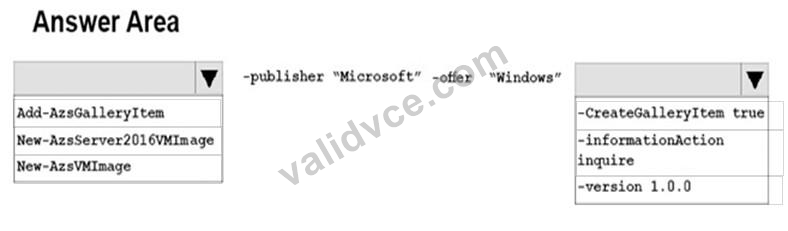
Correct Answer:
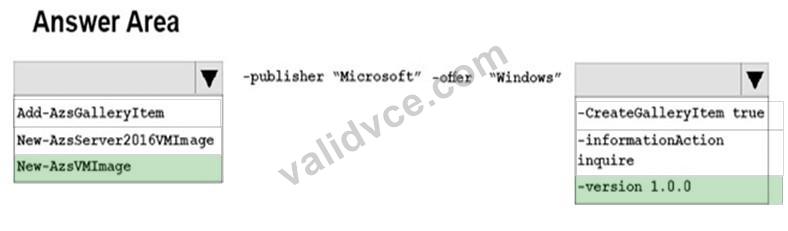
Explanation:
https://docs.microsoft.com/en-us/azure/azure-stack/azure-stack-add-vm-image#add-a-vm-image- to-marketplace-by-using-powershell
You deploy an Azure Stack integrated system that uses an external domain name of west.fabrikam.com Currently, tenant users access the system internally.
You need to create a SSL certificate for the publication of externally accessible endpoints. The solution must ensure that tenant users can upload VHD files to Azure Stack remotely. Which two names should you include in the certificate? Each correct answer presents part of the solution.
NOTE: Each correct selection is worth one point.
- A. *.blob.west.fabrikam.com
- B. adminmanagement.west.fabrikam.com
- C. *.west.fabrikam.com
- D. *.trafficmanager.west.fabrikam.com
- E. adminportal.west.fabrikam.com
Correct Answer: A,C 🗳️
Explanation: Only visible for ValidVCE members. You can sign-up / login (it's free).
You have an Azure Slack Development Kit deployment.
You receive a Storage Resource Provider alert indicating that a file share named SUl_ObjStore_4 on a volume named ObjStore_4 is more than 80 percent utilized. You verify that none of the storage accounts were recently deleted. You need to remediate the alert as quickly as possible.
Which two actions should you perform?
- A. From the Azure Stack Resource Manager user endpoint, run Start-AzsReclaimStorageCapacity.
- B. From the Azure stack administrator portal modify the retention period.
- C. From the Azure Stack user portal, delete a storage account.
- D. From the Azure Stack administrator portal, restart the infrastructure role.
- E. From the Azure Stack Resource Manager administrator endpoint, migrate a container from the SU1)ObjStore_4 file share to a file share on a different volume.
Correct Answer: A,D 🗳️
Viewing page 1 out of 21 pages.
Viewing questions 1-5 out of 105 questions.


 Kitty

 Sidney

 Warner
 Edwina

 Ashbur
 Kelly
 Tim
 Erica
 Violet
 Ethel
 William
 Chasel
 Hamiltion


