

Reading notes is one thing; sitting a timed, exam-style session is another. The ValidVCE test engines for the Cisco Implementing Cisco Application Centric Infrastructure - Advanced (300-630) recreate the pressure of the real testing environment, so the format feels familiar long before exam day.
Cisco 300-630 Exam Syllabus Topics:
| Section | Weight | Objectives |
|---|---|---|
| Multi-Pod Architecture | 20% | - Firewall and load balancer design in Multi-Pod - Service graph deployment in Multi-Pod - IPN (Inter-Pod Network) implementation - Packet flow between pods |
| ACI Packet Forwarding | 20% | - Packet forwarding between leaf switches (VXLAN) - Server NIC teaming integration with ACI - Endpoint learning optimizations
|
| Integration with Traditional Networks | 15% | - STP and BPDU handling in ACI - Network-centric vs application-centric design - Migration considerations from traditional networks |
| Multi-Site Architecture | 20% | - Inter-site communication - Stretched component options - Multi-Site Orchestrator (MSO) implementation - ISN (Inter-Site Network) configuration |
| Advanced ACI Policies and Integrations | 25% | - Layer 3 Out transit routing - Layer 3 Out VRF route leaking - VRF route leaking - Common tenant utilization - Layer 4 to Layer 7 Policy-Based Redirect (PBR) - Contract configuration and enforcement
|
Everything Candidates Want to Know About the 300-630 Exam
The Cisco Implementing Cisco Application Centric Infrastructure - Advanced exam is the official Cisco assessment behind the CCNP Data Center, Cisco Certified Specialist - Data Center ACI Advanced Implementation credential, which sits at the Professional level. Passing it confirms that your skills meet the vendor's current requirements rather than a textbook outline. It also connects with related certifications such as CCNP Data Center, Cisco Certified Specialist - Data Center ACI Advanced Implementation, so it can anchor a broader certification path.
According to the official exam information, the Cisco Implementing Cisco Application Centric Infrastructure - Advanced exam includes 55-65 questions and gives you 90 minutes to complete them. Treat that as a pacing exercise, not just a knowledge check: bank the questions you know first, flag the ones that stall you, and circle back instead of burning minutes on a single item. Before test day, run at least one full timed session in the ValidVCE desktop or online test engine, so the clock never feels unfamiliar when it counts.
To pass the Cisco Implementing Cisco Application Centric Infrastructure - Advanced exam you need Variable (approx. 750-850 / 1000), and the official registration fee is USD 300. Keep one thing in mind: a failed attempt is not discounted, so retaking the exam means paying USD 300 again in full. A practical safeguard is to sit a complete ValidVCE practice test a week or two before your exam date; if your timed scores are not sitting comfortably above the passing mark, consider pushing your booking back and drilling the weak domains first.
The official prerequisites for the Cisco Implementing Cisco Application Centric Infrastructure - Advanced exam are as follows: No formal prerequisites; recommended knowledge: CCNA, DCFNDU, DCACI, hands-on experience with Cisco ACI and Nexus 9000 switches. Requirements can change over time, so confirm the details on the official Cisco exam page at https://www.cisco.com/c/en/us/training-events/training-certifications/exams/current-list/dcacia-300-630.html before you book your seat.
You can register through the official channels listed below:
Exam delivery: Online proctored or onsite testing at Pearson VUE authorized centers.
Cisco points candidates toward the following official training options:
Official training builds the theory; the 120 practice questions from ValidVCE show you how that theory appears in exam-style items, which is where most study plans actually pay off.
Yes. A free PDF demo of the Cisco Implementing Cisco Application Centric Infrastructure - Advanced practice questions is available on the ValidVCE samples page, so you can check the question style and difficulty before spending anything. Every purchase also includes 365 days of free updates, and if your product expires after that period, you can extend the update service from your member zone at 50% off.
If you take the 300-630 exam within 60 days of your purchase and do not pass, ValidVCE offers a 100% money-back guarantee: send a scanned copy of your exam enrollment slip together with the official Score Report PDF within two days of your exam date, and the refund is processed within seven days. The candidate name must match the payer name, and the guarantee does not apply to exams taken within three days of purchase, to material that was downloaded without the exam actually being taken, or to free materials and expired orders. Prefer to keep studying instead? You can exchange your purchase for two additional exam products of equal value, free of charge, while keeping the update service on your original product. Delivery itself is instant: the download link is emailed within one minute of payment, and if nothing arrives within two hours, our support team will sort it out. There is no limit on how many computers you install the material on.
The Cisco Implementing Cisco Application Centric Infrastructure - Advanced syllabus is organized into 5 domains. The leading areas include Multi-Pod Architecture (20%), ACI Packet Forwarding (20%), and Multi-Site Architecture (20%). For the complete, topic-by-topic breakdown, scroll up to the Exam Topics section above.
Cisco Implementing Cisco Application Centric Infrastructure - Advanced Sample Questions:
Refer to the exhibit.
A company decided to decrease its routing footprint and remove RT-2 and RT-3 devices from its data center.
Because of that, the exit point must be created from all the tenants by using the common tenant. Which two configuration tasks must be completed to meet these requirements? {Choose two.)
- A. Update the L3Qut ExtEPG subnet in the common tenant with flag Shared Route Control Subnet and Aggregate Shared Routes.
- B. Change contract Ctr-3 scope to Global, consume it by all EPGs. and flag all subnets with flag Shared between VRFs.
- C. Export contract Clr-2 into (he tenant TN-1 and attach it as a consumer to all the EPGs in the tenant TN-1.
- D. Mark all subnets with flag Shared between VRFs and attach contract Ctr-3 as a provider to all the EPGs.
- E. Move subnets from all the bridge domains to the EPG level and mark them with flag Shared between VRFs.
Correct Answer: A,D 🗳️
Explanation: Only visible for ValidVCE members. You can sign-up / login (it's free).
What are two characteristics of network-centric design in Cisco ACI? (Choose two.)
- A. Applications define the network requirements
- B. EPGs are used formicro segmentation
- C. EPGs are different security zones
- D. There is open communication between EPGs
- E. A bridge domain has one subnet and one EPG
Correct Answer: D,E 🗳️
Explanation: Only visible for ValidVCE members. You can sign-up / login (it's free).
How is broadcast forwarded in Cisco ACI Multi-Pod after ARP flooding is enabled?
- A. Ingress replication is used on the spines to forward broadcast frames in the IPN infrastructure
- B. Broadcast frames are forwarded inside the pod and across the IPN using the multicast address that is associated to the bridge domain
- C. Within a pod, the ingress leaf switch floods the broadcast frame on all fabric ports
- D. For the specific bridge domain, all spines forward the broadcast frames to IPN routers
Correct Answer: B 🗳️
Explanation: Only visible for ValidVCE members. You can sign-up / login (it's free).
Which action should be taken in Cisco ACI to reassign a unique globally scoped pcTag to an EPG that provides a global contract?
- A. Configure subnets that are treated as virtual IP
- B. Configure subnets that are private to VRF
- C. Configure subnets that advertise externally
- D. Configure subnets that are shared between VRFs
Correct Answer: D 🗳️
Explanation: Only visible for ValidVCE members. You can sign-up / login (it's free).
Refer to the exhibit.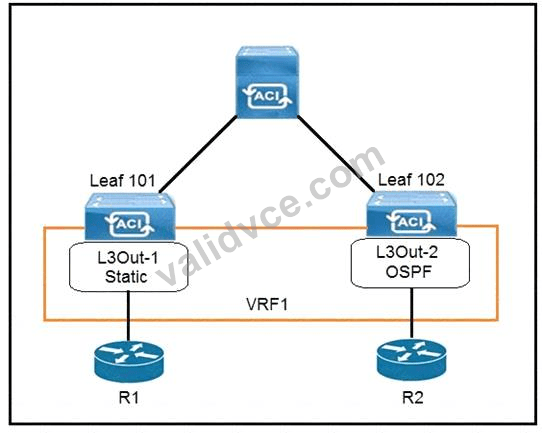
The 0.0.0.0/0 is configured as a default static route on L3Out-1. Which action should be taken for the 0.0.0.0/0 prefix to advertise out on L3Out-2 OSPF?
- A. Enable Shared Route Control Subnet
- B. Enable Shared Security Import Subnet
- C. Enable Aggregate Export Subnet
- D. Enable Export Route Control Subnet
Correct Answer: C 🗳️
Explanation: Only visible for ValidVCE members. You can sign-up / login (it's free).


 Tina
Tina 
 Simona
  Randolph
 Caroline
  Charlotte
  Ethel
Ethel  Gwendolyn
 Naomi
Naomi  Liz
Liz  Adelaide
  Margaret
  Brook
Brook  Charlotte
  Monroe
  Cliff
Cliff 


